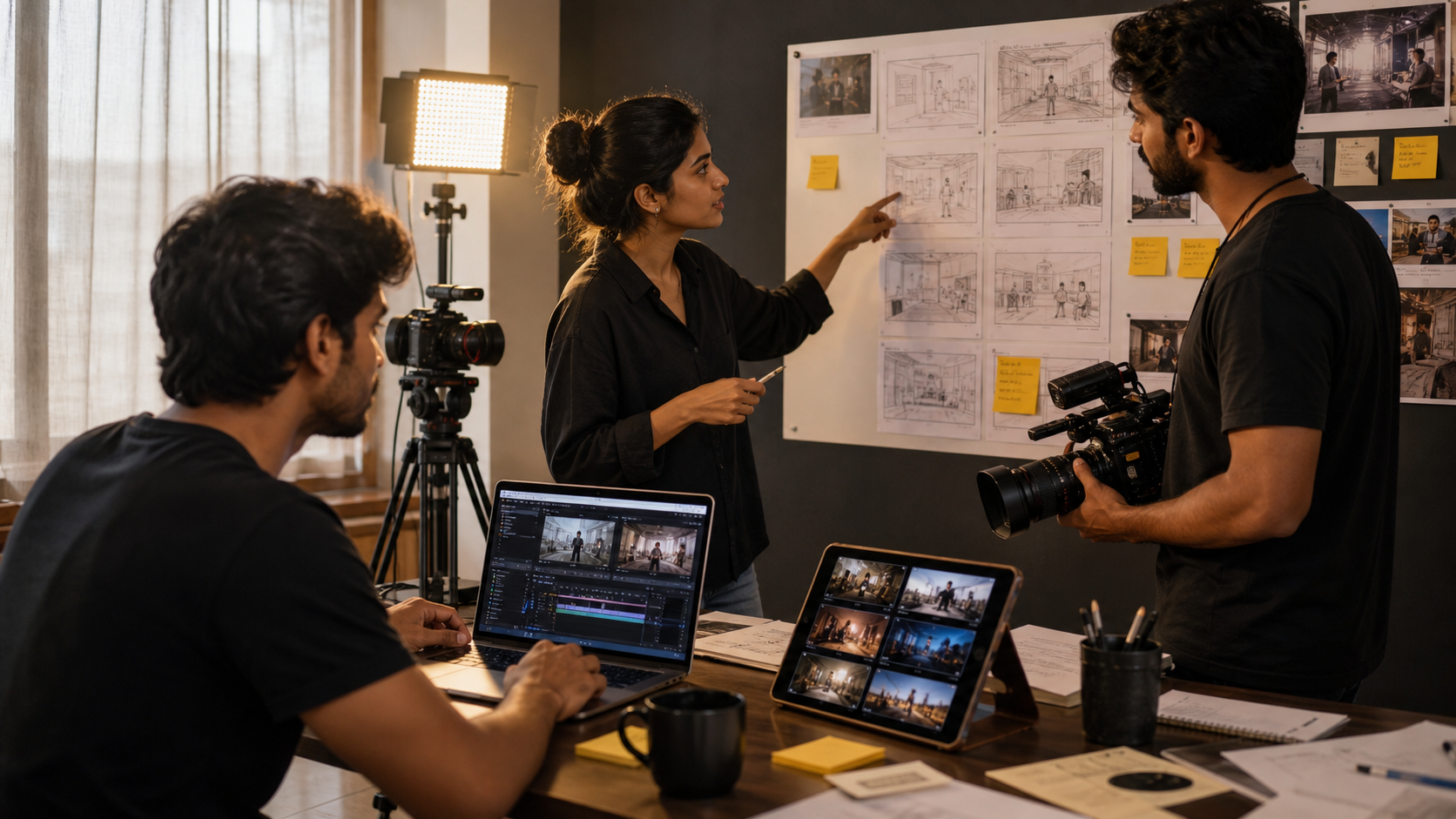
Direct answer: AI films are not the end of filmmaking. They are the beginning of a new production model where scripts, storyboards, concept visuals, edits, dubbing and even short video scenes can be created faster. But the strongest AI films will still need human taste, direction, storytelling, ethics and production judgment.
A few years ago, the idea of making films with AI sounded like a future prediction. In 2026, it is already part of the conversation.
Creators are experimenting with AI-generated scenes. Brands are using AI for concept videos, product films, ad variations and storyboards. Film festivals are creating dedicated AI categories. Production teams are testing AI in pre-production, editing, localization and post-production.
But the important question is not, "Will AI replace filmmakers?" That is too simple. The better question is: how will AI change who gets to make films, how fast films can be made, and what kind of stories become possible?
At Cosette Media, we see AI film production as a creative advantage when it is used properly. AI can reduce friction. It can help ideas become visual faster. It can help smaller teams produce more ambitious work. But it cannot replace the thing that makes a film memorable: the story, the emotion and the human decision behind every frame.
What Are AI Films?
AI films are films, ads, brand videos or visual stories where artificial intelligence is used meaningfully in the production process. That could mean AI-generated visuals, AI-assisted storyboarding, synthetic voice, automated editing, AI dubbing, image-to-video generation, virtual backgrounds or AI-supported VFX.
Not every AI film is fully generated. In fact, the best future may not be fully AI-made films. It may be hybrid filmmaking: real people, real direction, real cameras and real production thinking supported by AI tools.
For example, a brand film may still be shot with a real founder, real office, real team and real customer story. AI may help build moodboards, pre-visualize shots, create scene references, clean audio, generate alternate edits or produce social cutdowns faster.
That is where AI becomes useful: not as a replacement for filmmaking, but as a production layer inside filmmaking.
Why AI Filmmaking Is Becoming Serious Now
AI filmmaking is becoming serious because three things are happening at the same time.
Video demand is exploding. Brands need reels, ads, product videos, founder videos, internal films, explainers and campaign assets constantly. Traditional production can be slow and expensive for that volume.
AI tools are improving quickly. Text-to-video, image-to-video, editing assistance, voice tools, dubbing and generative VFX are making it easier to create visual drafts and finished assets.
Creative platforms are legitimizing the format. Runway's 2026 AI Festival includes film as a formal track, with submissions requiring generative video and a fully contained linear narrative. That matters because it shows AI filmmaking is moving from novelty to recognized creative practice.
McKinsey's 2026 report on AI in film and TV also points to AI being deployed across development, pre-production, physical production and post-production. The impact is uneven, and premium storytelling is still hard, but the production pipeline is clearly being affected.
What AI Can Already Do in Film Production
AI is already useful in several parts of the film production process.
Concept development: AI can help explore ideas, visual styles, character references, environments and campaign directions before a shoot begins.
Storyboarding and pre-visualization: Directors can create rough frames, scene references and moodboards faster, making it easier for clients and teams to understand the creative direction.
Editing support: AI can help organize footage, identify selects, clean audio, create rough cuts, generate captions and speed up repetitive post-production tasks.
Localization: Dubbing, subtitling and adaptation for different markets can become faster, which is especially useful for brands working across India and global audiences.
Social cutdowns: One long brand film can become multiple reels, shorts, teasers and ad variations with less manual effort.
Visual experimentation: AI can help test different treatments before spending money on full production.
This is a big opportunity for creators and agencies. The team that can combine film sense with AI workflow will be able to move faster without making the work feel generic.
What AI Still Cannot Replace
AI can generate visuals. It cannot automatically create meaning.
A good film is not only a sequence of beautiful shots. It has rhythm, emotional logic, tension, performance, pacing, framing and a reason to exist. AI can assist with pieces of that process, but direction still matters.
AI also struggles with consistency across longer stories. Character continuity, subtle acting, brand tone, legal clearance, cultural nuance and premium production standards are still difficult. McKinsey notes that many industry leaders see current AI-generated output as not yet meeting premium production standards in many cases.
That is why the future is not simply "prompt and publish." The future is likely "direct, review, refine and produce."
Human filmmakers will still decide what is worth saying. AI will help them get there faster.
Future Scope of AI Films for Creators
For creators, AI films open a serious opportunity.
A young filmmaker who does not have access to a large studio can now create concept films, spec ads, music visuals, fashion films, travel films and short narratives with a much smaller setup. This does not remove the need for craft. It changes the entry barrier.
The creators who will win are not the ones who only know prompts. They will be the ones who understand story, camera language, editing, sound, color, brand emotion and audience psychology. AI will reward creative taste because tools are becoming available to everyone.
In India, this matters even more. There is huge demand for video content, but many brands cannot afford large production budgets for every campaign. AI-assisted production can help creators serve more brands with faster concepts, sharper pre-production and more variations.
Future Scope of AI Films for Brands
For brands, AI film production can reduce the gap between idea and execution.
A brand can test multiple film concepts before choosing one. It can create campaign previews before shoot day. It can turn one brand film into multiple social-first assets. It can localize videos faster. It can create visual explainers without needing a full-scale shoot every time.
But brands should be careful. AI-made content that looks cheap, strange or emotionally empty can damage trust. The goal should not be to replace production quality. The goal should be to use AI where it improves speed, clarity and experimentation.
For serious brand films, founder videos, corporate films and performance creatives, the strongest approach will be hybrid: human strategy, real production where needed, AI-assisted workflows where useful.
What About Ethics, Consent and IP?
AI films bring real questions around consent, likeness, copyright, training data, watermarks and disclosure.
OpenAI's Sora safety documentation, for example, discusses visible and invisible provenance signals, C2PA metadata, watermarking and consent-based likeness controls. These are not small details. They show that AI video is powerful enough to need clear guardrails.
For brands, the rule should be simple: do not use a person's face, voice, style or copyrighted material without permission. Disclose AI involvement where it matters. Keep records of tools, prompts, assets and rights. Do not build brand trust on unclear creative ownership.
AI films will grow, but responsible AI filmmaking will matter more than fast AI filmmaking.
What Cosette Media Believes
Cosette Media believes AI will change film production, but it will not remove the need for filmmakers.
The future belongs to creative teams that can combine story, direction, production quality and AI workflow. AI can help us ideate faster, visualize faster, edit faster and adapt faster. But the brand still needs a point of view. The film still needs emotion. The final work still needs human taste.
For brands in Delhi NCR, Noida, Gurgaon and across India, this is the time to start experimenting. Not by replacing every shoot with AI, but by building a smarter content engine where AI supports strategy, film production, reels, ads and brand storytelling.
AI films are coming. The brands that understand them early will have an advantage.
Frequently Asked Questions
What are AI films?
AI films are films, ads or video stories where artificial intelligence is used meaningfully in the production process, such as AI-generated visuals, storyboarding, editing, dubbing, VFX, image-to-video or content adaptation.
Will AI replace filmmakers?
AI may replace some repetitive production tasks, but it will not replace strong filmmakers. Storytelling, direction, emotion, performance, taste, ethics and final creative judgment still need human skill.
What is the future scope of AI filmmaking in India?
AI filmmaking has strong scope in India because brands need more video content at faster speed and lower cost. Creators who combine film craft with AI workflows can serve brand films, reels, ads, explainers, music videos and social-first campaigns.
Can brands use AI films for marketing?
Yes. Brands can use AI-assisted films for concept videos, product explainers, ad variations, campaign previews, social cutdowns and visual storytelling. For high-trust brand films, hybrid production is usually stronger than fully AI-generated content.
Can Cosette Media help with AI-assisted films?
Yes. Cosette Media helps brands combine human-led film production, brand storytelling, content strategy and AI-assisted workflows for faster, sharper and more scalable video content.
Want to explore AI-assisted films for your brand?
Email: [email protected]
Phone / WhatsApp: +91 92115 08493
Website: www.cosettemedia.com
Sources: McKinsey on AI in film and TV production, Runway AI Festival 2026, and OpenAI on AI video provenance and safety.