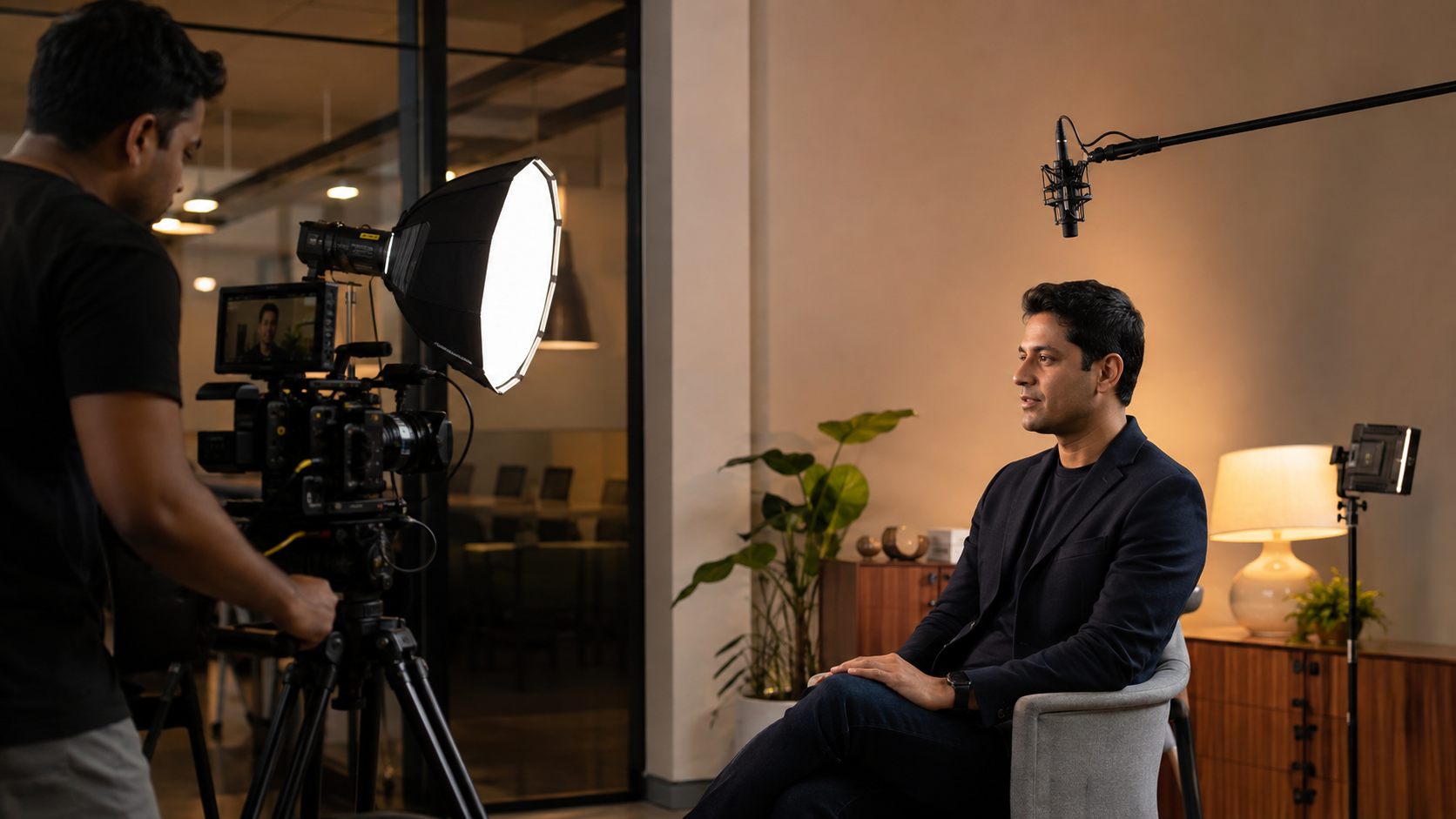
Direct answer: A professional founder interview shoot combines message planning, a controlled camera frame, flattering lighting, clean sound and calm direction. The goal is not simply to record a founder speaking. It is to create a credible master interview that can become a website film, social clips, sales answers, advertisements and internal communication without making the speaker sound scripted or artificial.
Founder-led video works because buyers can see who is behind the business. But a camera alone does not create trust. The interview has to sound clear, look intentional and answer questions that matter to the audience.
At Cosette Media, we treat a founder interview as both a production and a content system. The production must feel premium, while the conversation must remain natural enough to sound like the person rather than a brochure.
Why does a founder interview need planning before the shoot?
The strongest interview starts with the communication goal. Is the founder explaining the company story, answering buyer objections, introducing a service, recruiting people or building authority around an industry point of view?
Without that decision, the conversation becomes broad and the editor has to search for a useful story inside a long recording. Before production, we normally define:
The audience and what they already understand
The single message the main video must communicate
Three to five supporting ideas or proof points
Common questions the sales team receives
The intended platforms and video formats
The action a viewer should take next
This is also where scripting needs judgement. A word-for-word script can be useful for a short announcement, but it often makes a longer founder interview sound over-rehearsed. A structured question list and concise talking points usually preserve the founder's real voice. Our guide to scripted but natural founder content explains this balance in more detail.
How should the camera be set up for a founder interview?
A professional frame should direct attention toward the speaker without making the setup feel severe. Camera height, eyeline, lens choice, background distance and headroom all influence how confident and approachable the founder appears.
We first choose whether the speaker will look directly into the lens or toward an interviewer positioned just beside it. Direct-to-camera delivery feels immediate and works well for explainers, advertisements and website messages. An off-camera eyeline usually feels more conversational and suits stories, testimonials and documentary-style interviews.
A second camera can add visual variety and make edits easier, but it is not automatically necessary. One carefully composed camera is better than two inconsistent angles. When two cameras are used, their colour, exposure and eyelines must feel like one visual system.
The background also has a job. It should provide context without competing with the face. In an office shoot, we may use depth, furniture, practical lamps or subtle brand details, while removing distractions that make the frame look accidental.
What makes interview lighting look natural and premium?
Interview lighting should shape the face, protect natural skin tone and create separation from the background. It should not announce itself before the speaker begins talking.
A common approach uses a soft key light as the main source, controlled fill or negative fill to manage contrast, and a background or edge light when the room needs more depth. The exact setup changes with the person's face, glasses, clothing, skin tone and location.
Glasses deserve particular attention because a large light can create distracting reflections. Small changes to the light height, camera angle or the position of the speaker can solve the problem without making the face look flat.
Existing room light must also be considered. Mixed colour temperatures can make skin look inconsistent, and uncontrolled daylight may shift during a long interview. A short lighting test before recording saves much more time than trying to repair every shot during colour grading.
Why is sound as important as the picture?
Viewers may tolerate a simple background, but unclear audio makes an interview difficult to trust and tiring to watch. Offices often contain air-conditioning noise, traffic, hard walls and empty rooms that create echo.
Our audio check includes listening to the room before placing microphones, reducing avoidable noise, positioning the microphone close enough for a clear voice, monitoring with headphones and recording a short test. Depending on the location, a lavalier microphone, a boom microphone or both may be used.
We also capture room tone and watch for jewellery, clothing or table movement that can create noise. These small details rarely appear in a showreel, but they strongly affect the finished video.
How do you direct a founder without making the answers feel fake?
Good interview direction creates safety and clarity. We begin with easier questions so the speaker can settle into the environment, then move toward more detailed answers. Rather than asking for a perfect performance, we listen for the strongest idea and help the founder express it more simply.
Useful direction may include asking for a shorter version, requesting a concrete example, removing jargon or repeating the first sentence with more energy. When an answer is too long, we break it into separate thoughts that can stand alone as clips.
The objective is not to erase personality. Pauses, natural phrasing and a genuine point of view are often what make founder content believable. This is one reason founder videos can support B2B trust before a sales conversation.
How can one interview become a complete content library?
Repurposing must be planned before recording. If the team only asks questions for one three-minute film, the footage may not contain clean openings, self-contained answers or strong calls to action for short-form content.
A well-planned founder interview can support:
A main website or company-story video
Several short educational clips for LinkedIn and Instagram
Answers to frequently asked sales questions
Short paid-ad variations with focused hooks
Quotes and ideas for articles, captions and carousels
Internal presentations, recruitment or onboarding content
Each version still needs its own edit. A website film needs narrative flow, while a social clip needs a fast context-setting opening. An advertisement needs a specific problem, proof and action. Our video editing and post-production service handles these platform-specific decisions rather than exporting the same cut in different dimensions.
What should a founder prepare before the production day?
The founder does not need to memorise a speech. It is more useful to review the audience, key messages, proof points and examples. Clothing should be comfortable, visually clean and distinct from the background. Fine patterns and noisy accessories are best avoided.
The internal team should confirm the location, availability, brand requirements, approvals and the final action viewers should take. They should also share real customer questions. These usually produce more valuable answers than generic prompts about mission and vision.
Allow enough time for setup and conversation. Rushing the first answer because the room was booked too tightly often costs more than scheduling the shoot properly.
How does Cosette Media manage a founder interview production?
Cosette Media connects strategy, filming, direction and post-production within one workflow. We plan the communication goal, question architecture, camera and lighting setup, audio, visual coverage and the formats required after the shoot. The same source material can then support a brand film, social media system, sales communication and paid creative.
Brands in Noida, Delhi, Gurgaon and the wider Delhi NCR can explore our brand film and video production service or review our broader social media content capabilities.
Managed content-production engagements generally start from Rs.45,000 + GST. Final pricing depends on strategy, shoot duration, crew, location, number of cameras, editing complexity and the number of final deliverables.
Frequently asked questions
How long does a professional founder interview shoot take?
The recorded interview may take 45 to 90 minutes, but the production also needs time for camera, lighting and sound setup, testing, adjustments and supporting visual footage. The complete session is scoped around the number of messages and deliverables required.
Should a founder read from a teleprompter?
A teleprompter works well for precise announcements and short direct-to-camera sections. For longer interviews, structured questions and talking points usually sound more natural. The right choice depends on the speaker and the intended format.
Is one camera enough for an interview?
Yes. One well-planned camera can produce a strong interview. A second angle adds flexibility and visual variety, but lighting, sound, direction and message quality matter more than the number of cameras.
Can the interview be turned into Reels and advertisements?
Yes, when repurposing is planned before filming. Questions should be designed to produce focused, self-contained answers, and supporting footage should be captured for platform-specific edits.
Plan a founder interview that keeps working after the shoot
A founder interview should become more than one video. With the right strategy and production, it can give the website a credible human voice, answer buyer questions, support sales and create months of useful content.
To plan a professional founder interview or brand video with Cosette Media, email [email protected], call or WhatsApp +91 92115 08493, or start a conversation with our team.