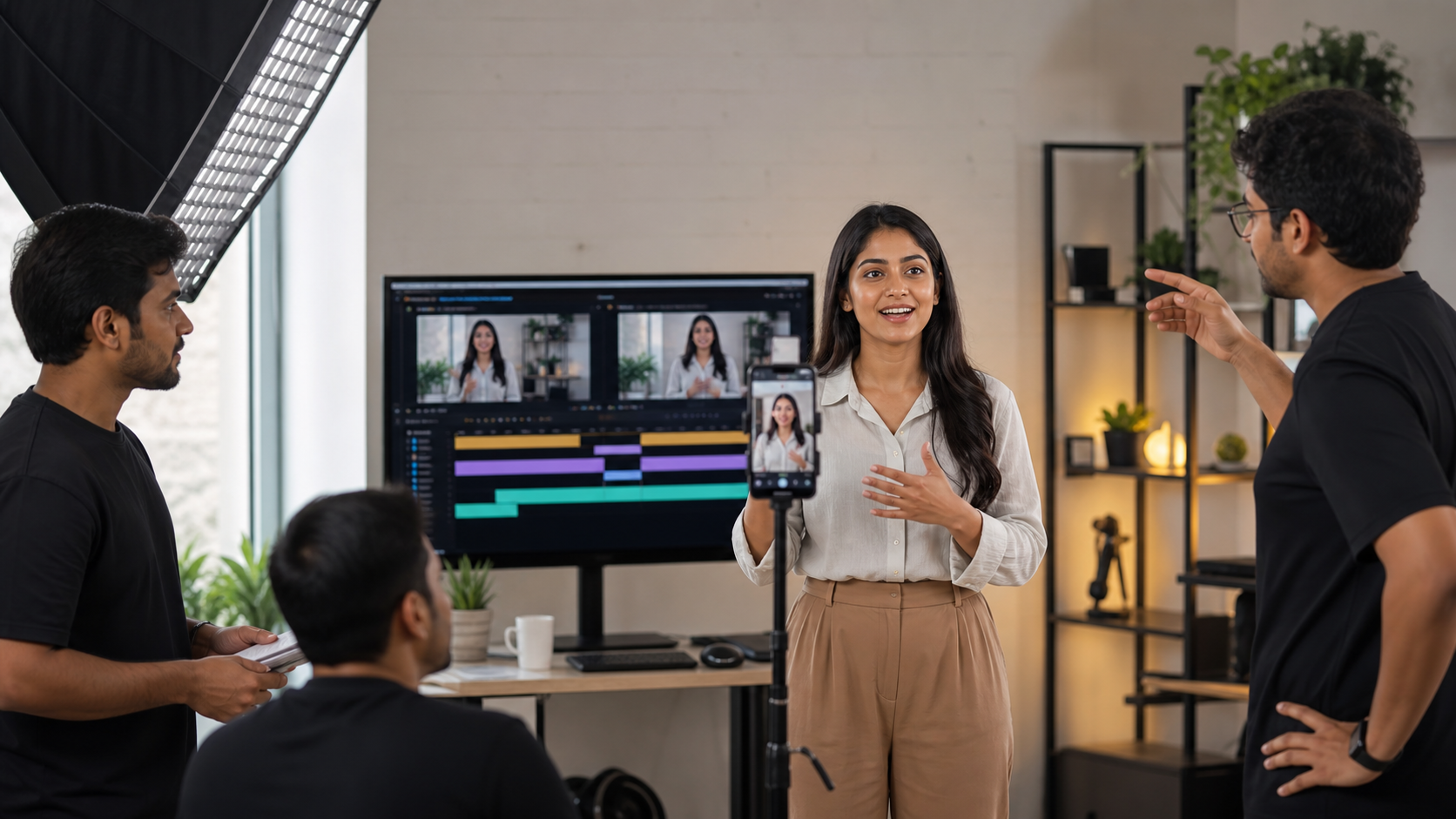
Direct answer: Multilingual Reels help Delhi NCR brands reach Hindi- and English-speaking audiences without producing two separate content calendars. The best approach is to shoot one strong master concept, adapt the delivery for each audience, add accurate subtitles, and distribute each version according to platform, geography and buyer intent.
Delhi NCR is not a single-language market. A technology buyer in Noida may prefer an English explainer. A real estate customer in Greater Noida may respond more naturally to Hindi or Hinglish. A founder may sound credible in English during a LinkedIn video but warmer and more relatable in Hindi on Instagram.
The opportunity is not simply to translate more content. It is to make the same brand idea feel native to different viewers.
Meta reported in June 2026 that AI-powered Reels translation was expanding across languages and that more than half a billion Facebook users were watching AI-translated videos weekly. This does not mean every brand should automate every voice. It shows that language is becoming less of a distribution barrier. The advantage will come from combining translation technology with human judgement, local context and strong production.
Why Multilingual Video Matters for Delhi NCR Brands
English-only content can communicate expertise, especially in B2B, technology and professional services. Hindi and Hinglish can create familiarity, clarity and emotional connection. The right mix depends on the audience and the buying situation.
A multilingual strategy can help a brand:
explain complex services in the language customers use naturally;
make founder-led videos feel more comfortable and credible;
adapt one shoot for Instagram, Facebook, LinkedIn and YouTube;
test whether language changes watch time, enquiries or lead quality;
reach local audiences without making the brand feel generic.
This is particularly useful for real estate, healthcare, education, hospitality, retail and local professional services. These categories often serve customers who research in English but discuss the decision in Hindi.
Translation Is Not the Same as Localisation
Literal translation changes words. Localisation preserves meaning, tone and cultural context.
For example, an English hook such as "Your content is getting attention but not generating qualified leads" may sound stiff when translated word for word. A stronger Hinglish version could begin with the real frustration the audience feels: "Views aa rahe hain, lekin serious enquiries kahan hain?"
The idea stays the same, but the rhythm changes.
Good localisation also decides what should not be translated. Product names, technical terms and brand phrases may need to remain in English. A Hindi version should not become so formal that it feels distant. An English version should not remove the warmth that made the original speaker believable.
A Practical Multilingual Reels Workflow
1. Start With One Buyer Question
Build each Reel around a question customers already ask. Examples include "How much does a corporate film cost?", "Why are our ads not converting?" and "How many Reels should a business publish each month?"
One clear question makes adaptation easier and creates a concise answer that search engines and AI answer systems can understand.
2. Write a Master Script, Then Adapt It
Create the strongest version in the speaker's most natural language. Then rewrite it for the second language instead of translating sentence by sentence. Keep the hook, proof and call to action consistent while allowing the delivery to change.
3. Shoot Both Versions in One Session
Record the English, Hindi or Hinglish variations during the same setup. Lighting, camera, location and crew are already in place, so the extra production time is much lower than organising another shoot.
Cosette Media's content creation services in Delhi NCR use this batch-production approach to create platform-ready variations efficiently.
4. Use AI for Assistance, Not Final Judgement
AI tools can create draft subtitles, transcripts and dubbed versions. A human reviewer should still check names, prices, local expressions, pronunciation and timing. For a visible founder or spokesperson, a poorly matched synthetic voice can reduce trust even when the translation is technically correct.
5. Publish by Audience, Not Just by Language
Do not upload both versions everywhere without a reason. The English version may suit LinkedIn and a B2B landing page. The Hinglish version may perform better on Instagram or as a Meta ad. A Hindi edit may work well for a local audience segment in Noida, Ghaziabad or Faridabad.
How Should Brands Measure Multilingual Reels?
Compare meaningful signals across versions:
three-second hold and average watch time;
saves, shares and profile visits;
qualified direct messages and WhatsApp enquiries;
landing-page visits and booked calls;
lead quality by language and geography.
Do not assume the version with more views is the winner. An English Reel with 8,000 views may produce more B2B enquiries than a Hindi Reel with 30,000 views. The correct result depends on the business goal.
For stronger measurement, connect the content plan to a broader social media strategy for Delhi NCR and use distinct links or campaign labels where possible.
How Much Does Multilingual Reels Production Cost?
The cost depends on the number of videos, shoot days, locations, presenters, scripting and whether dubbing or multiple on-camera versions are required. Cosette Media's full-production content programmes start from Rs.45,000 + GST, with scope tailored to the number of platforms and deliverables.
Planning both language versions before the shoot is usually more efficient than translating finished videos later.
Build One Idea for More Than One Audience
Multilingual Reels are not a shortcut to automatic reach. They are a way to make useful brand ideas accessible to more people while protecting tone and credibility.
Cosette Media helps brands across Noida and Delhi NCR plan, script, shoot and distribute bilingual social content as one connected system. To discuss a multilingual content programme, email [email protected] or call +91 92115 08493.
Frequently Asked Questions
Should a Delhi NCR brand create Reels in Hindi or English?
Use the language your target customer understands and trusts in that buying situation. Many brands benefit from English for expertise-led B2B content and Hindi or Hinglish for local reach, familiarity and consumer communication.
Is AI dubbing good enough for branded Reels?
AI dubbing is useful for testing and scaling, but it still needs human review. Check pronunciation, emotional tone, timing, legal claims and whether the synthetic delivery matches the visible speaker.
Should both language versions use the same visuals?
They can share footage, but hooks, on-screen text, pacing and calls to action may need adaptation. Reusing production assets is efficient; copying every creative decision is not always effective.
Do multilingual Reels help SEO and AEO?
They can improve discoverability when each version has accurate captions, descriptive titles, useful surrounding copy and a relevant landing page. Transcripts also give search and answer systems clearer context about the video's topic.
How many bilingual Reels should a brand publish each month?
Start with four to eight strong concepts and create language variations only where audience data supports them. Quality, consistency and relevance matter more than producing two versions of every post.
Source: Meta on AI-translated Reels.