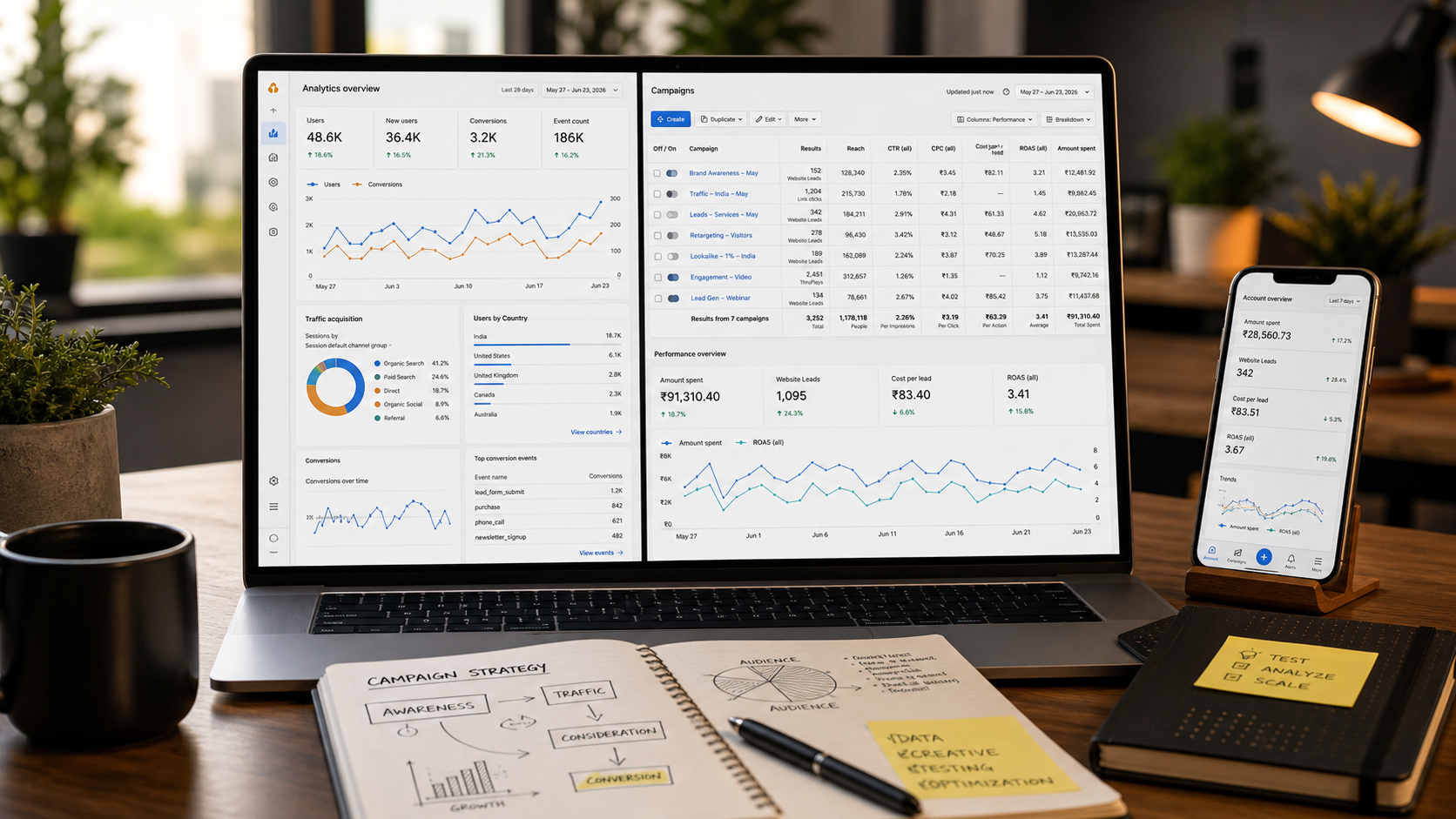
Performance marketing is marketing where every rupee is tied to a measurable action.
That action could be a lead, purchase, app install, booked site visit, WhatsApp enquiry, product demo, or any other conversion that matters to your business. Instead of judging marketing only by likes, reach, or impressions, performance marketing asks a sharper question:
Did this campaign create a result we can track, improve, and scale?
For Indian brands in 2026, this matters more than ever. Media costs are rising, customer attention is fragmented, and almost every category has more competition than it did even two years ago. A D2C skincare brand, a real estate developer, a fashion label, and a B2B SaaS company may all use different platforms, but the goal is the same: turn marketing spend into business growth.
This guide explains what performance marketing means, how it works, which channels matter, and how to build a system that does not just spend money on ads, but learns from every campaign.
What Is Performance Marketing?
Performance marketing is a digital marketing approach where campaigns are planned, measured, and optimised around specific outcomes.
Traditional brand marketing often focuses on awareness: people seeing your name, remembering your product, or associating your brand with a category. Performance marketing focuses on measurable actions such as:
- Website purchases
- Lead form submissions
- WhatsApp enquiries
- Phone calls
- Demo bookings
- Store visits
- App installs
- Newsletter signups
- Add-to-cart events
- Shows the product in use
- Makes the problem feel familiar
- Explains the offer quickly
- Builds trust with proof
- Compares options
- Answers an objection
- Gives people a reason to act now
- Page views
- Lead submissions
- Calls or WhatsApp clicks
- Purchases
- Add-to-cart events
- Cost per lead or cost per purchase
- Conversion rate
- Return on ad spend
- Pausing weak ads
- Testing new hooks
- Improving landing pages
- Shifting budget to stronger campaigns
- Separating branded and non-branded search
- Reducing wasted keywords
- Improving lead quality
- Retargeting warm audiences
- "buy organic sunscreen online"
- "2 bhk flats in Noida"
- "best performance marketing agency India"
- "corporate video production company"
- Conversion events
- Pixel and tag setup
- UTM structure
- Landing page analytics
- CRM lead source tracking
- Weekly reporting format
- Hook
- Offer
- Audience
- Landing page
- Format
- Keyword group
- CTA
- Increasing budget on winning campaigns
- Expanding keyword coverage
- Creating new creatives from winning angles
- Building remarketing sequences
- Improving landing page conversion rate
- Adding email or WhatsApp follow-up
- Is the offer clear?
- Is the audience specific?
- Is the proof strong?
- Is the next step easy?
- Is the price aligned with the value?
- A product or service people already search for
- A clear offer
- A website or landing page that can convert
- Enough budget to test properly
- A team that can respond to leads quickly
- A business goal that can be measured
- Your website is incomplete
- You cannot explain your offer in one sentence
- You do not know your margins
- You cannot track leads or purchases
- You want instant results without testing
- How many conversions do we need to learn?
- What is an acceptable cost per lead or sale?
- What is the sales value of one customer?
- How long is the buying cycle?
- How many creatives can we test this month?
- How they structure campaigns
- What they test first
- How they track conversions
- How they report business outcomes
- How they work with your sales or ecommerce data
- How often they refresh creative
- What they need from your team to succeed
The simplest way to understand it:
Brand marketing builds demand. Performance marketing captures, tests, and scales demand.
The best brands need both. But if your current problem is that you are spending money without knowing what is working, performance marketing is where the cleanup begins.
How Performance Marketing Works
A good performance marketing campaign has four parts: targeting, creative, tracking, and optimisation.
1. Targeting
Targeting decides who sees your campaign.
On Google, targeting is often based on search intent. Someone searching "best real estate projects in Gurgaon" or "performance marketing agency India" is already showing interest.
On Meta, targeting is usually based on interests, behaviours, lookalikes, engagement, and creative signals. The platform learns from the people who respond to your ads and tries to find more people like them.
For Indian brands, targeting also needs local nuance. A campaign for premium real estate in Mumbai should not be structured like a campaign for affordable housing in Lucknow. A D2C fashion brand selling across India needs different messaging for first-time buyers, repeat customers, and high-intent cart abandoners.
2. Creative
Creative is the ad itself: the video, image, headline, offer, hook, landing page promise, and call to action.
This is where many campaigns fail. Brands often treat creative as decoration, but in performance marketing, creative is the variable that makes the algorithm work. A weak campaign with strong targeting can still fail if the ad does not stop attention or explain the offer clearly.
Useful creative usually does one of these jobs:
For example, a real estate ad that only says "Luxury homes starting at..." may get leads, but a video that shows location access, floor plan logic, sample flat details, and possession timeline will usually attract more qualified enquiries.
3. Tracking
Tracking connects marketing activity to business outcomes.
At minimum, a performance setup should track:
This usually means setting up Google Analytics 4, Google Tag Manager, Meta Pixel, Google Ads conversion tracking, and clean UTM parameters. For lead-heavy businesses, CRM tracking is just as important because a cheap lead is useless if the sales team cannot convert it.
Without tracking, you are not doing performance marketing. You are only running ads.
4. Optimisation
Optimisation is the process of improving campaigns based on data.
This includes:
The goal is not to make one perfect campaign. The goal is to create a system that keeps learning.
Performance Marketing Channels That Matter in India
Different channels solve different problems. The right mix depends on your category, budget, sales cycle, and how much demand already exists.
Google Search Ads
Google Search works best when people already know what they want.
Examples:
Search campaigns are strong for high-intent leads and purchases, but they can become expensive if the account is not structured well. Branded keywords, competitor keywords, broad match terms, and low-quality search queries all need careful control.
Best for: high-intent demand capture, service businesses, real estate, B2B, local services, and D2C products with existing search demand.
Meta Ads
Meta Ads, including Instagram and Facebook, are strong for demand generation.
People may not open Instagram planning to buy a product or enquire about a property, but the right creative can create interest quickly. This makes Meta especially useful for D2C brands, fashion, beauty, food, lifestyle, real estate launches, and content-led lead generation.
The creative testing system matters more than tiny audience tweaks. A campaign with five sharp creative angles usually teaches you more than one campaign with endless targeting variations.
Best for: visual products, D2C, real estate launches, retargeting, offer testing, and top-of-funnel demand.
YouTube Ads
YouTube is useful when the product needs more explanation.
It can work well for real estate walkthroughs, education brands, B2B offers, founder-led brands, and products where trust matters before purchase. YouTube also helps build warmer retargeting audiences for Google and Meta campaigns.
Best for: storytelling, product education, trust building, and video-led remarketing.
LinkedIn Ads
LinkedIn can be expensive, but it is often useful for B2B campaigns where job title, industry, company size, or seniority matters.
It is rarely the first channel we recommend for every B2B brand because costs can climb quickly. But for high-ticket services, enterprise SaaS, recruitment, consulting, and niche B2B offers, LinkedIn can support demand generation when the offer and landing page are strong.
Best for: B2B lead generation, enterprise targeting, founder-led authority, and high-ticket services.
Retargeting
Retargeting brings back people who already interacted with your brand.
These could be website visitors, Instagram engagers, video viewers, abandoned cart users, or past leads. Retargeting usually performs better than cold traffic because the audience already has some familiarity with the brand.
The mistake is showing the same ad again and again. Good retargeting answers the next question in the buyer's mind: proof, pricing, benefits, objections, case studies, testimonials, FAQs, or a stronger offer.
Best for: improving conversion rate, recovering lost buyers, and staying visible during longer decision cycles.
Performance Marketing vs Digital Marketing
Digital marketing is the broad category. Performance marketing is one part of it.
Digital marketing can include SEO, social media, content marketing, influencer marketing, email marketing, website design, community building, and brand campaigns. Not all of these are directly tied to a measurable conversion.
Performance marketing is narrower. It focuses on campaigns where results can be tracked and optimised against business goals.
Here is the practical difference:
A strong marketing system uses both. SEO and content build long-term authority. Performance campaigns generate measurable data and faster feedback.
Metrics Every Brand Should Track
If you want performance marketing to work, track the metrics that connect to business outcomes.
Cost Per Lead
Cost per lead tells you how much you spend to generate one enquiry.
But do not optimise only for the cheapest lead. A real estate campaign can generate low-cost leads that never answer calls. A B2B campaign can generate fewer leads but better decision-makers. Lead quality matters.
Conversion Rate
Conversion rate shows how many visitors take the action you want.
If your ads are getting clicks but no conversions, the issue may be the landing page, offer, loading speed, form length, trust signals, or mismatch between ad promise and page content.
Customer Acquisition Cost
Customer acquisition cost, or CAC, shows how much it costs to acquire a paying customer.
This is more useful than cost per lead for D2C and subscription businesses because it connects ad spend to actual revenue.
Return on Ad Spend
ROAS compares revenue generated to ad spend.
For example, if you spend Rs. 1,00,000 and generate Rs. 4,00,000 in tracked revenue, the ROAS is 4x. But ROAS should always be read with margins. A 4x ROAS can be excellent for one brand and weak for another depending on product cost, repeat purchase rate, and fulfilment expenses.
Lead-to-Sale Rate
For service, real estate, and B2B brands, lead-to-sale rate is critical.
If campaigns generate 500 leads but the sales team closes none, the ad account is only one part of the problem. You need to inspect lead quality, response time, sales scripts, follow-up process, and offer clarity.
A Simple Performance Marketing Framework
At Cosette Media, we think about performance marketing through a simple operating system: Measure, Test, Scale.
Measure
Before spending aggressively, make sure tracking is correct.
This includes:
If the measurement is broken, every decision after that becomes unreliable.
Test
Testing should happen in controlled batches.
Test one major variable at a time:
For example, a D2C fashion brand could test three creative angles: new collection, styling ideas, and social proof. A real estate brand could test location convenience, project amenities, and investment value.
The point is not to guess which angle will work. The point is to let the market tell you.
Scale
Scaling means increasing spend only after the system has proof.
Good scaling looks like:
Bad scaling is simply doubling the budget because one good day happened.
Common Performance Marketing Mistakes
Most campaigns do not fail because the platform is bad. They fail because the system around the platform is weak.
Mistake 1: Optimising for Vanity Metrics
Reach, likes, and views can be useful, but they are not the final result.
If a campaign is meant to generate leads, judge it by qualified leads. If it is meant to generate sales, judge it by purchases and revenue. If it is meant to build remarketing audiences, judge it by cost per useful audience action.
Mistake 2: Running Ads Without Landing Page Discipline
Many brands send paid traffic to slow, confusing, or generic pages.
Your landing page should match the ad promise, load quickly, explain the offer, build trust, and make the next step obvious. Even small improvements in landing page conversion rate can reduce acquisition cost.
Mistake 3: Testing Too Many Things at Once
If you change the audience, creative, offer, budget, and landing page at the same time, you will not know what caused the result.
Good testing is boring in the best way. It isolates variables so the learning is clear.
Mistake 4: Ignoring Sales Follow-Up
For lead generation, speed matters.
If a lead comes in from an ad and nobody calls for six hours, campaign performance will look worse than it really is. The sales process is part of the performance system.
Mistake 5: Expecting Ads to Fix a Weak Offer
Ads can amplify demand. They cannot magically create a strong product, clear pricing, credible proof, or a compelling reason to buy.
Before scaling, ask:
When Should Indian Brands Invest in Performance Marketing?
You should invest in performance marketing when you have at least one of these:
You may not be ready if:
Performance marketing works best when the business has enough clarity to let data do its job.
How Much Budget Do You Need?
There is no universal budget because categories behave differently.
A local service campaign can start smaller than a national D2C campaign. A real estate lead generation campaign needs a different budget than an ecommerce remarketing campaign. A B2B campaign with high-ticket deals may tolerate a higher cost per lead than a low-margin product business.
Instead of asking "What is the minimum budget?", ask:
As a simple rule, your first budget should be large enough to test multiple creatives and generate enough data to make decisions. Spending too little can be just as wasteful as spending too much because the account never gets enough signal.
What to Look for in a Performance Marketing Agency
If you are hiring a performance marketing agency in India, do not choose only by the lowest retainer or the biggest promise.
Look for a team that can explain:
Good performance marketing is not just media buying. It includes strategy, creative, analytics, landing pages, reporting, and ongoing learning.
An agency should be able to tell you what is working, what is not working, why it may be happening, and what they are testing next.
Final Takeaway
Performance marketing is not just about running Google Ads or Meta Ads. It is a measurable growth system.
For Indian brands in 2026, the winners will not be the ones who spend the most. They will be the ones who track properly, test consistently, improve creative, connect ads to sales data, and scale only when the numbers make sense.
If your campaigns are generating clicks but not business results, the problem may not be the platform. It may be the system.
Cosette Media helps Indian brands build performance marketing systems across paid advertising, content, video, and conversion strategy. If you want to understand what is working, what is wasting budget, and what to scale next, book a performance marketing consultation with our team.
Frequently Asked Questions
What is performance marketing in simple words?
Performance marketing is a marketing approach where campaigns are measured by specific actions such as leads, purchases, calls, bookings, or signups. The goal is to track what works and improve campaigns based on real results.
Is performance marketing the same as digital marketing?
No. Digital marketing is the wider category that includes SEO, social media, content, email, and paid ads. Performance marketing is focused specifically on measurable outcomes like conversions, revenue, and return on ad spend.
Which platform is best for performance marketing in India?
It depends on the business. Google Ads works well when people are already searching for your product or service. Meta Ads works well for visual products, D2C brands, real estate launches, and demand generation. Many brands need both.
How long does performance marketing take to work?
You can often see early signals within a few weeks, but stable performance usually takes testing. The first phase should focus on clean tracking, creative testing, landing page improvement, and lead quality analysis.
Do small businesses need performance marketing?
Yes, if they have a clear offer and can track enquiries or sales. Small businesses should start with focused campaigns, controlled budgets, and simple conversion goals instead of trying to run every channel at once.
About the Author
Harry is the founder of Cosette Media, a performance marketing and content creation agency based in India. He works with D2C brands, real estate developers, and B2B companies on paid advertising, video content, and growth strategy. When he is not running campaigns, he is building the content systems he writes about here.